*After the Roman period, Bath remained a small town until the 18th century, when it became a fashionable spa destination for the wealthy. The architect John Wood the Elder designed much of the city’s Georgian architecture, including the famous Royal Crescent and the Circus. Bath also played an important role in the English literary scene, as several famous authors, including Jane Austen, lived and wrote in the city. During the 19th century, Bath’s popularity declined as other spa towns became fashionable. In the 20th century, the city experienced significant redevelopment and preservation efforts, including the restoration of its Roman baths and the construction of a new spa complex.
Today, Bath is a UNESCO World Heritage Site and a popular tourist destination known for its historical and cultural significance.
“The only true sport is that which arises spontaneously
from the heart and the blood.”
— Alistair MacLean
The University of Stirling has produced several famous athletes over the years. Here are a few examples:
Duncan Scott: Duncan Scott is a Scottish swimmer who graduated from the University of Stirling in 2018. He has won numerous medals at major international competitions, including the Olympics, the World Championships, and the Commonwealth Games.
Andy Murray: While Andy Murray did not technically graduate from the University of Stirling, he did attend the university for a brief period in the early 2000s. Murray is a famous Scottish tennis player who has won multiple Grand Slam titles and an Olympic gold medal.
Ross Murdoch: Ross Murdoch is a Scottish swimmer who graduated from the University of Stirling in 2016. He has won multiple medals at major international competitions, including the Commonwealth Games.
Robbie Renwick: Robbie Renwick is a Scottish swimmer who graduated from the University of Stirling in 2009. He has won multiple medals at major international competitions, including the Olympics and the Commonwealth Games.
“Port Meadow is absolutely beautiful and a wonderful place to swim. We often swim in a different spot from other open water swimming groups in order to create a more relaxed environment – especially for our beginners. We do special beginners swims on Saturdays, to ease new members into the practise slowly and very carefully.
Safety is paramount, so I’ll walk them in to the water and they can immerse themselves as much as they want. We never allow anyone to jump or dive into cold water – the shock can cause a swimmer to gulp for air and subsequently ingest water; it’s always a gentle process.” — Ellie
Dogs have been bred for a variety of purposes throughout history, including as working animals to support agriculture. Dogs have been bred for specific traits that make them well-suited to work on farms, such as intelligence, obedience, strength, and endurance*.
Supported by funding from the European Research Council and the Natural Environment Research Council, a large international team of scientists compared genetic data with existing archaeological evidence and show that man’s best friend may have emerged independently from two separate (possibly now extinct) wolf populations that lived on opposite sides of the Eurasian continent.
* Here are a few examples of how dogs were bred to support agriculture:
Herding dogs: Dogs such as the Border Collie, Australian Cattle Dog, and German Shepherd were bred to help farmers manage livestock by herding them from one place to another. These dogs have a natural instinct to gather and control herds of animals, and they can be trained to respond to a farmer’s commands.
Hunting dogs: Many breeds of dogs, such as the Labrador Retriever, were originally bred as hunting dogs to assist farmers with hunting game for food. These dogs have a keen sense of smell and are skilled at tracking and retrieving prey.
Guard dogs:Certain breeds of dogs, such as the Great Pyrenees, were bred to protect livestock from predators such as wolves and bears. These dogs are fiercely protective of their flock and will guard them from any perceived threat.
Draft dogs: Some large breeds of dogs, such as the Bernese Mountain Dog and the Saint Bernard, were bred to pull carts and wagons on farms. These dogs are strong and muscular and can move heavy loads across long distances.
Overall, dogs have been bred for centuries to support agriculture in a variety of ways. Their intelligence, loyalty, and hardworking nature have made them invaluable assets to farmers and have helped to shape the course of human history.
This British festive pastry has origins dating back to the 13th century when European Crusaders returned from the Middle East with recipes containing meats, fruits, and spices. These early pies, known as “mincemeat pies,” combined minced meat (usually mutton), suet, fruits, and spices such as cinnamon, cloves, and nutmeg, symbolizing the gifts of the Magi. In the 16th century, the pies were rectangular, representing Jesus’ crib.
Over time, the meat content reduced, and by the Victorian era, the recipe had evolved to primarily include dried fruits, suet, and spices, aligning with the modern version of the mince pie. Traditionally enjoyed during the Christmas season, mince pies are now small, round pastries filled with a mixture called mincemeat, which typically contains no meat but a blend of dried fruits, sugar, spices, and sometimes brandy or other spirits.
Last night, after a 3 year break, we were delighted to once again host our Festive Networking Drinks 🎄 in person, at the Oxford & Cambridge Club, London.
We had a great turn out with almost 60 fellows, students & alumni braving the cold to socialise & network with their peers. pic.twitter.com/WX7aVskMsi
— Kellogg College, University of Oxford (@KelloggOx) December 14, 2022
The Eurocodes are ten European standards (EN; harmonised technical rules) specifying how structural design should be conducted within the European Union. These were developed by the European Committee for Standardization upon the request of the European Commission. The purpose of the Eurocodes is to provide:
A means to prove compliance with the requirements for mechanical strength and stability and safety in case of fire established by European Union law.[2]
A basis for construction and engineering contract specifications.
A framework for creating harmonized technical specifications for building products (CE mark).
Since March 2010 the Eurocodes are mandatory for the specification of European public works and are intended to become the de facto standard for the private sector. The Eurocodes therefore replace the existing national building codes published by national standard bodies, although many countries have had a period of co-existence. Additionally, each country is expected to issue a National Annex to the Eurocodes which will need referencing for a particular country (e.g. The UK National Annex). At present, take-up of Eurocodes is slow on private sector projects and existing national codes are still widely used by engineers.
Eurocodes appear routinely on the standing agendas of several of our daily colloquia, among them the AEDificare, Elevator & Lift and Hello World! colloquia. See our CALENDAR for the next online meeting; open to everyone.
So proud to announce the @ellisoninst is beginning construction on our new campus at the @UniofOxford and broadening our mission: Science & Engineering for Humanity. EIT develops & deploys technology in pursuit of solving four of humanity’s most challenging & enduring problems.… pic.twitter.com/vSkHWSS8EK
Abstract.This article makes three related arguments. First, that although many definitions of the smart city have been proposed, corporate promoters say a smart city uses information technology to pursue efficient systems through real-time monitoring and control. Second, this definition is not new and equivalent to the idea of urban cybernetics debated in the 1970s. Third, drawing on a discussion of Rio de Janeiro’s Operations Center, I argue that viewing urban problems as wicked problems allows for more fundamental solutions than urban cybernetics, but requires local innovation and stakeholder participation. Therefore the last section describes institutions for municipal innovation and IT-enabled collaborative planning.
So proud to announce the @ellisoninst is beginning construction on our new campus at the @UniofOxford and broadening our mission: Science & Engineering for Humanity. EIT develops & deploys technology in pursuit of solving four of humanity’s most challenging & enduring problems.… pic.twitter.com/vSkHWSS8EK
…”The Society has ruled on the acceptable dimensions of the Yorkshire pudding and is now issuing the definitive recipe. The judgement followed an enquiry from an Englishman living in the Rockies in the USA who emailed the RSC seeking scientific advice on the chemistry of the dish following a string of [altitude related] kitchen flops….”
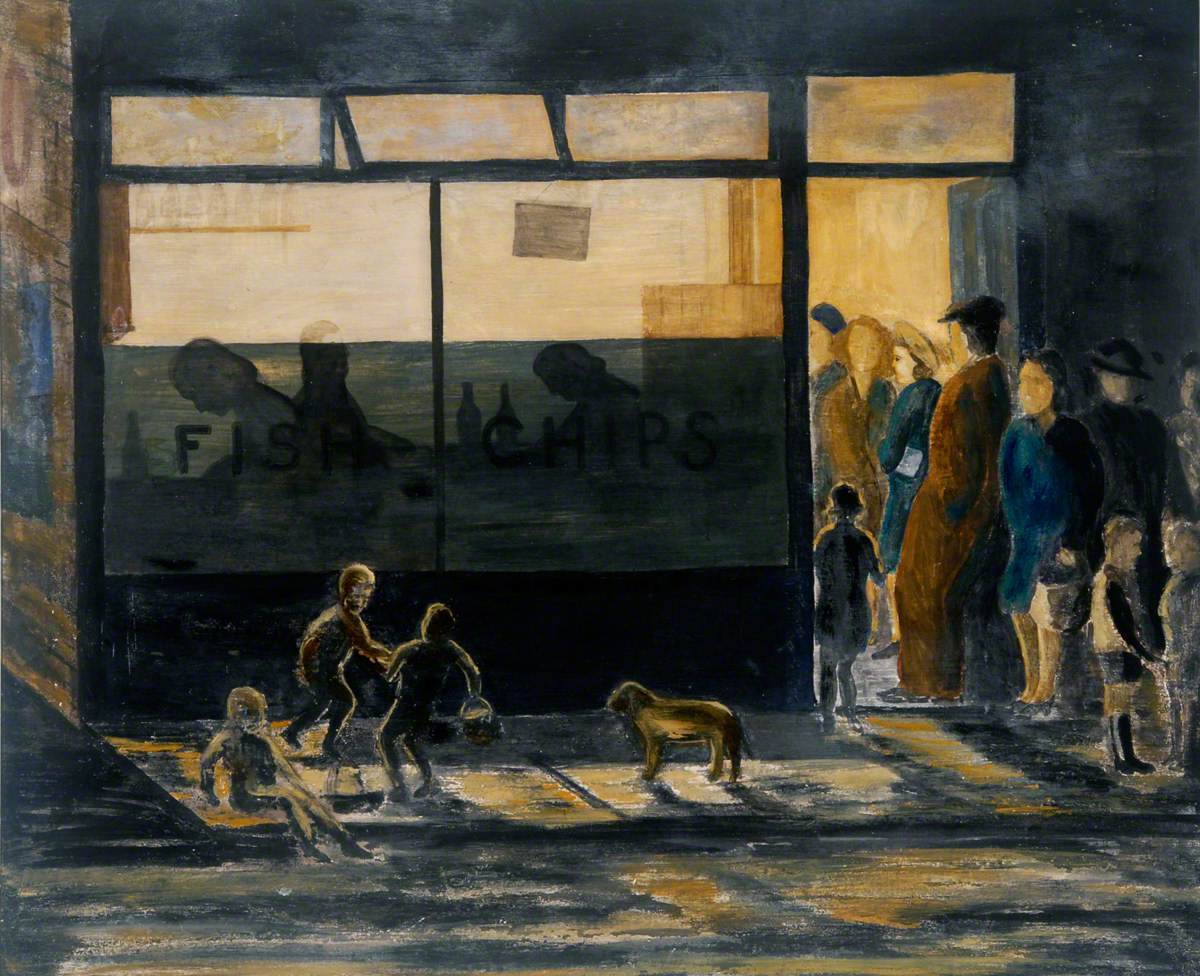
“Fish and chips was in many ways the pioneer fast-food industry. It became an essential component of working-class diet and popular culture in parts of London, and over wide areas of industrial midland and northern England and southern Scotland, in the early decades of the twentieth century…I propose to argue that the fish and chip trade was not only important enough in itself to justify sustained historical analysis, but also that it provides a useful vantage point for examining important changes in British society more generally.”
— John Walken, 1998, Journal of Social History
In England I’m in a very international community. I’m meeting students attempting to learn English, they are from all over the world. Many have never heard of Jesus, some have heard the name and nothing more. It’s amazing, a kind smile and warm conversation is a perfect pretext… pic.twitter.com/jLiDAc8nlU
New update alert! The 2022 update to the Trademark Assignment Dataset is now available online. Find 1.29 million trademark assignments, involving 2.28 million unique trademark properties issued by the USPTO between March 1952 and January 2023: https://t.co/njrDAbSpwBpic.twitter.com/GkAXrHoQ9T